Microbiology & Urinalysis · Report Format
Urine Routine Examination Report Format — Sample & Free Download
A Urine Routine Examination (urinalysis) checks the physical appearance, chemical composition, and microscopic content of urine — colour, specific gravity, pH, protein, glucose, blood, and cell counts — to screen for urinary tract infections, kidney disease, diabetes, and other conditions.
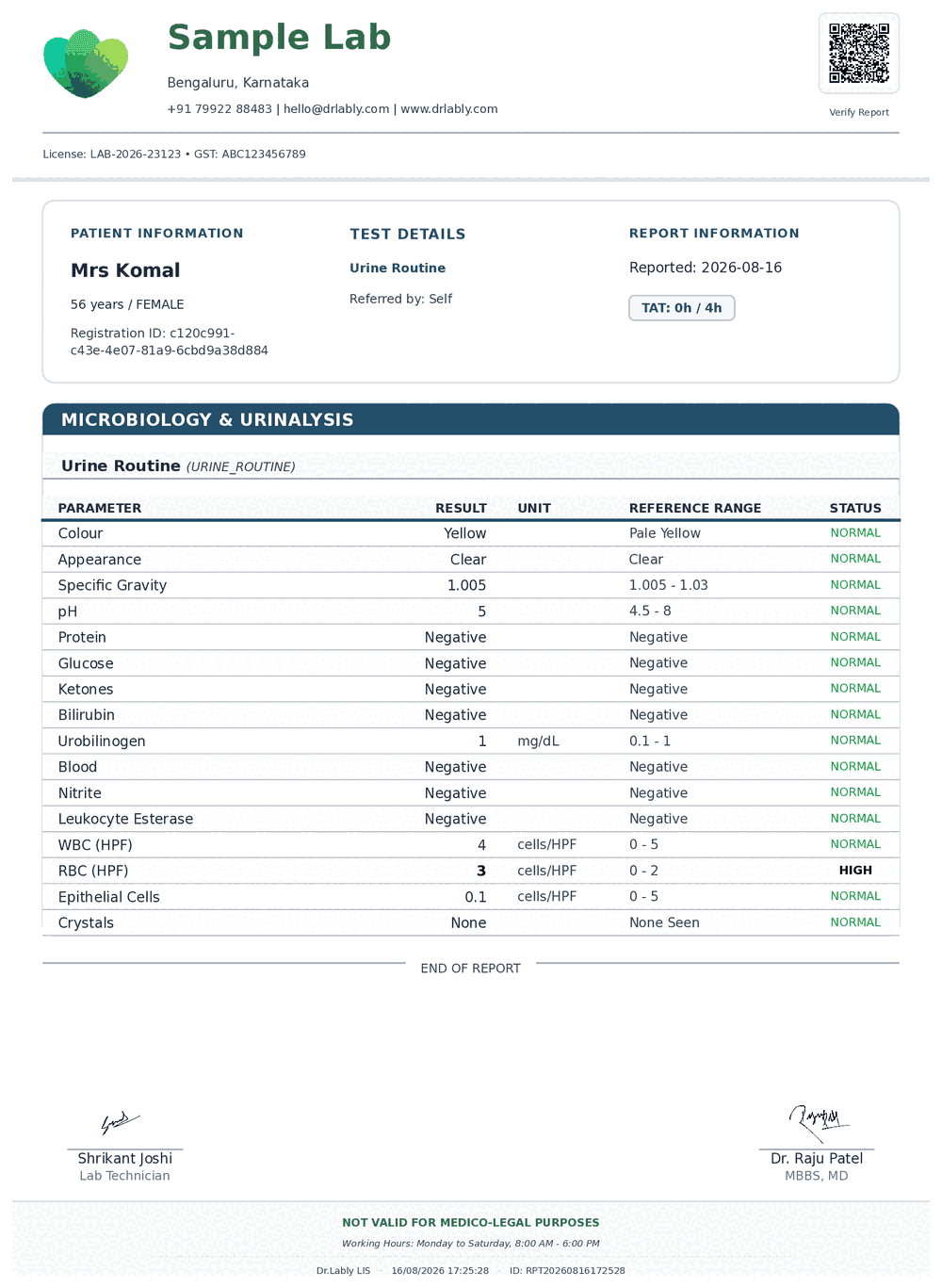
This is a real report generated by Dr.Lably LIS — not a mockup.
When is it ordered?
- Routine health checkups and pre-employment or antenatal screening
- Investigating suspected urinary tract infection, burning micturition, or frequency
- Monitoring diabetes, kidney disease, or pregnancy-related conditions
- Follow-up after treatment for a urinary or kidney condition
Test details
- Specimen type
- Random or midstream urine
- Turnaround time
- Same day (4 hours)
- Preparation
- A clean-catch midstream urine sample is preferred; no fasting is required.
Urine Routine Examination report format breakdown
| Parameter | Unit | Normal range | What it means |
|---|---|---|---|
| Colour | — | Pale Yellow | Darker or unusual colours can point to dehydration, blood in the urine, certain foods, or medications. |
| Appearance | — | Clear | Cloudiness can suggest infection, crystals, or excess cells in the urine. |
| Specific Gravity | — | 1.005 - 1.03 | Reflects how concentrated or dilute the urine is; helps assess hydration and kidney concentrating ability. |
| pH | — | 4.5 - 8 | Can shift with diet, infection, or certain metabolic conditions; extreme values can also affect crystal formation. |
| Protein | — | Negative | Persistent protein in urine can indicate kidney disease and usually warrants follow-up testing. |
| Glucose | — | Negative | Glucose in urine is often linked to uncontrolled diabetes, since it usually appears once blood sugar exceeds the kidney's reabsorption threshold. |
| Ketones | — | Negative | Ketones can appear with fasting, low-carbohydrate diets, or uncontrolled diabetes (diabetic ketoacidosis). |
| Bilirubin | — | Negative | Presence of bilirubin can indicate liver dysfunction or bile duct obstruction. |
| Urobilinogen | mg/dL | 0.1 - 1 | Abnormal levels can reflect liver dysfunction or increased red blood cell breakdown. |
| Blood | — | Negative | Blood in urine can come from infection, kidney stones, or other urinary tract conditions and generally needs follow-up. |
| Nitrite | — | Negative | A positive nitrite result suggests certain bacteria commonly associated with urinary tract infections. |
| Leukocyte Esterase | — | Negative | A positive result suggests white blood cells in the urine, often from infection or inflammation. |
| WBC (HPF) | cells/HPF | 0 - 5 | Elevated white blood cells under the microscope support a diagnosis of urinary tract infection or inflammation. |
| RBC (HPF) | cells/HPF | 0 - 2 | Elevated red blood cells can indicate infection, stones, trauma, or other urinary tract conditions. |
| Epithelial Cells | cells/HPF | 0 - 5 | A few epithelial cells are normal; higher numbers can reflect contamination during collection or, less commonly, tissue irritation. |
| Crystals | — | None Seen | Certain crystal types can be a normal finding, while others may point to metabolic conditions or stone-forming risk. |
Frequently asked questions
What does a Urine Routine report format include?
A Urine Routine report covers physical parameters (colour, appearance, specific gravity), chemical parameters (pH, protein, glucose, ketones, bilirubin, urobilinogen, blood, nitrite, leukocyte esterase), and microscopic findings (WBC, RBC, epithelial cells, crystals) — each with its result, reference range, and status, as shown in the sample report above.
How should the urine sample be collected?
A clean-catch midstream sample in a sterile container is preferred to avoid contamination that could affect the results; no fasting is needed.
What does a positive nitrite or leukocyte esterase result mean?
Both are markers suggestive of a urinary tract infection, though a doctor typically confirms with a urine culture, especially if symptoms are present.
How fast can I get a Urine Routine report?
Dr.Lably-powered labs typically report Urine Routine results the same day, often within about 4 hours of sample collection.
Related report formats
Generate reports like this for your lab
Dr.Lably LIS generates this exact report format automatically for every urine routine examination — with your lab's branding, QR verification, and WhatsApp/email delivery built in.
This page is for informational purposes only and is not a substitute for professional medical advice or diagnosis. Reference ranges shown are illustrative and may vary by lab, analyzer, age, gender, and methodology — always interpret results with a qualified physician.