Immunology & Serology · Report Format
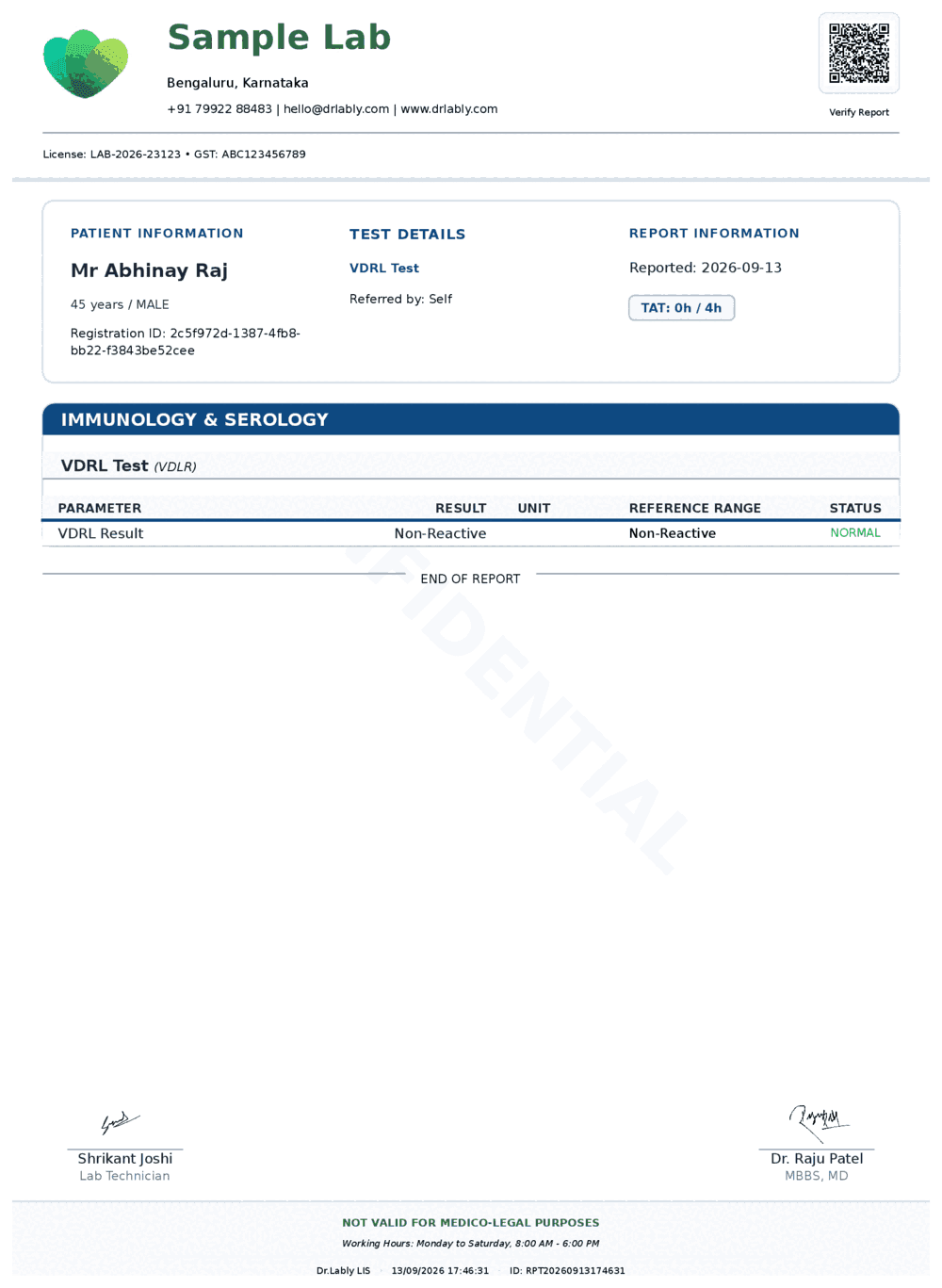
VDRL Test Report Format — Sample & Free Download
A VDRL (Venereal Disease Research Laboratory) test is a screening test for syphilis that detects non-specific antibodies produced in response to Treponema pallidum infection. Reactive results are always confirmed with a specific treponemal test.
This is a real report generated by Dr.Lably LIS — not a mockup.
When is it ordered?
- Routine antenatal or pre-marital screening
- Investigating symptoms suggestive of syphilis, such as genital sores or rash
- Blood donor and pre-surgical screening
- Follow-up testing to monitor treatment response, since titres fall after successful treatment
Test details
- Specimen type
- Serum
- Turnaround time
- Same day (4 hours)
VDRL Test report format breakdown
| Parameter | Unit | Normal range | What it means |
|---|---|---|---|
| VDRL Result | — | Non-Reactive | A Non-Reactive result suggests no current syphilis infection; a Reactive result needs a confirmatory treponemal test (such as TPHA or FTA-ABS) since VDRL can give false positives with other conditions. |
Frequently asked questions
What does a VDRL report format show?
The report lists the VDRL Result (Reactive or Non-Reactive) with its reference value and status, plus a clinical notes section — as shown in the sample report above.
Do I need to fast before a VDRL test?
No fasting or special preparation is needed for a VDRL test.
Does a Reactive VDRL always mean syphilis?
Not always — VDRL can give false positives with conditions like pregnancy, autoimmune disease, or certain infections, so a Reactive result is always followed up with a confirmatory treponemal test such as TPHA.
How long does a VDRL report take?
Dr.Lably-powered labs typically report VDRL results the same day, often within about 4 hours of sample collection.
Related report formats
Generate reports like this for your lab
Dr.Lably LIS generates this exact report format automatically for every vdrl test — with your lab's branding, QR verification, and WhatsApp/email delivery built in.
This page is for informational purposes only and is not a substitute for professional medical advice or diagnosis. Reference ranges shown are illustrative and may vary by lab, analyzer, age, gender, and methodology — always interpret results with a qualified physician.