Biochemistry · Report Format
Renal Function Test with Electrolytes (RFT) Report Format — Sample & Free Download
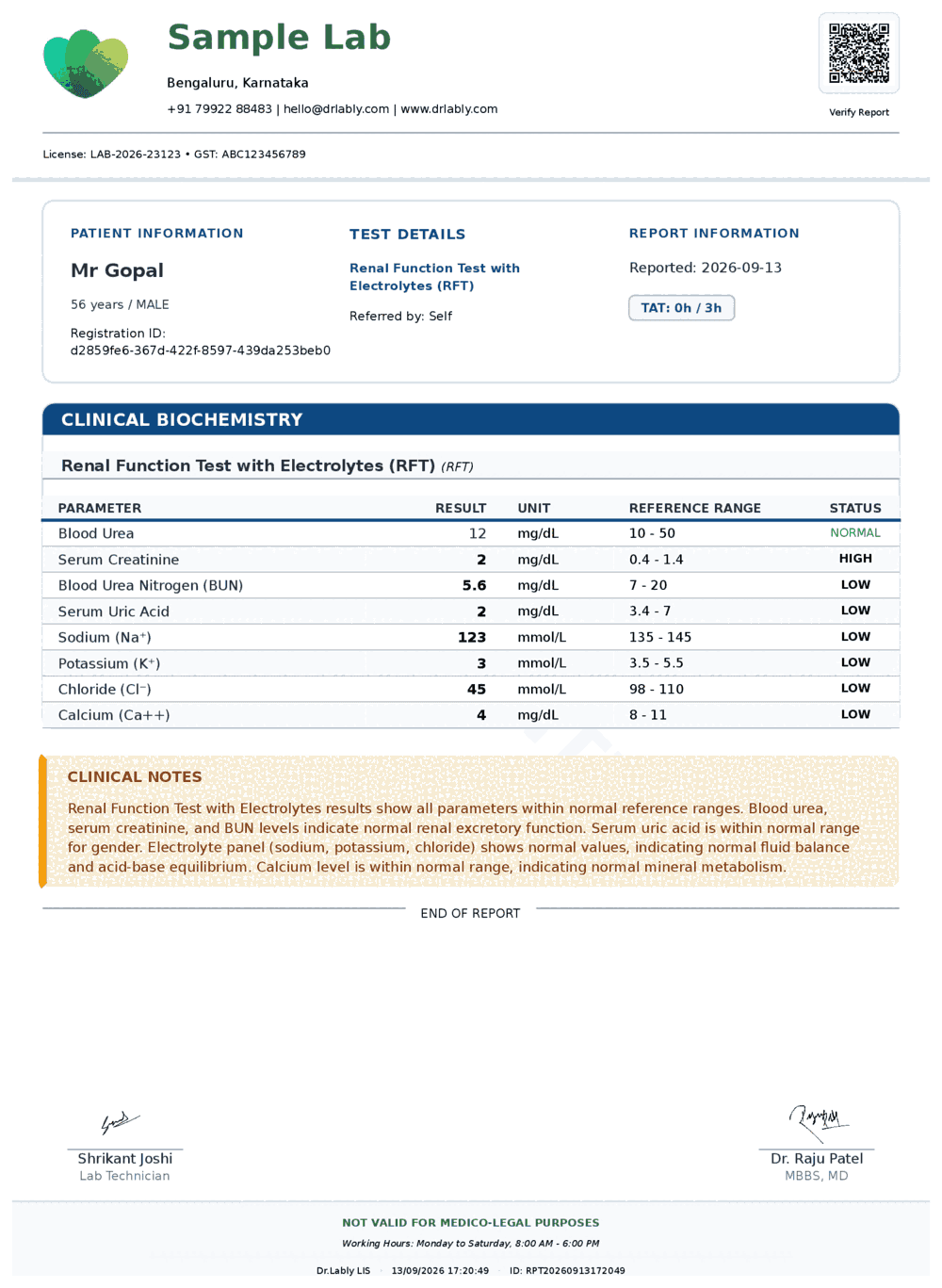
A Renal Function Test with Electrolytes (RFT) is an extended kidney panel that combines the standard renal markers (blood urea, creatinine, BUN, uric acid) with serum electrolytes (sodium, potassium, chloride, calcium) to give a fuller picture of kidney function and fluid/electrolyte balance.
This is a real report generated by Dr.Lably LIS — not a mockup.
When is it ordered?
- Evaluating kidney function alongside electrolyte and fluid balance in one panel
- Investigating swelling, reduced urine output, or unexplained fatigue
- Monitoring patients on medications that affect the kidneys or electrolytes, such as diuretics
- Critical care and hospital monitoring where electrolyte shifts need close tracking
Test details
- Specimen type
- Serum
- Turnaround time
- Same day (3 hours)
Renal Function Test with Electrolytes report format breakdown
| Parameter | Unit | Normal range | What it means |
|---|---|---|---|
| Blood Urea | mg/dL | 10 - 50 | High levels can indicate reduced kidney function, dehydration, or a high-protein diet. |
| Serum Creatinine | mg/dL | 0.4 - 1.4 | The most direct marker of kidney filtering capacity — high levels usually indicate reduced kidney function. |
| Blood Urea Nitrogen (BUN) | mg/dL | 7 - 20 | Rises with reduced kidney function or dehydration; low levels can occur with liver disease or a low-protein diet. |
| Serum Uric Acid | mg/dL | 3.4 - 7 | High levels are linked to gout risk and can also reflect reduced kidney clearance; interpreted alongside the other renal parameters in this panel. |
| Sodium (Na+) | mmol/L | 135 - 145 | Reflects fluid balance; both high and low sodium can affect neurological function and need clinical correlation. |
| Potassium (K+) | mmol/L | 3.5 - 5.5 | Critical for heart and muscle function; both high and low potassium can be dangerous and often need urgent correlation with an ECG. |
| Chloride (Cl-) | mmol/L | 98 - 110 | Tends to move together with sodium; helps assess acid-base and fluid balance. |
| Calcium (Ca++) | mg/dL | 8 - 11 | Reflects bone, parathyroid, and kidney health; both high and low levels need clinical correlation. |
Frequently asked questions
What parameters appear on an RFT report format?
An RFT report lists blood urea, serum creatinine, BUN, and uric acid alongside sodium, potassium, chloride, and calcium — each with its result, unit, reference range, and status, as shown in the sample report above.
How is RFT different from a standard KFT?
RFT includes the same core kidney markers as a KFT but adds a full electrolyte panel (sodium, potassium, chloride), making it more comprehensive for hospital and critical-care monitoring.
Do I need to fast for an RFT?
Usually no special preparation is required for RFT, but confirm with your lab if it's combined with other fasting tests.
Why does potassium need urgent attention when abnormal?
Potassium directly affects heart rhythm, so significantly high or low levels are often flagged for urgent clinical correlation, sometimes alongside an ECG.
Related report formats
Generate reports like this for your lab
Dr.Lably LIS generates this exact report format automatically for every renal function test with electrolytes — with your lab's branding, QR verification, and WhatsApp/email delivery built in.
This page is for informational purposes only and is not a substitute for professional medical advice or diagnosis. Reference ranges shown are illustrative and may vary by lab, analyzer, age, gender, and methodology — always interpret results with a qualified physician.